CyberDefenders - Rhadamanthys Lab
Writeup · Rhadamanthys Lab
CyberDefenders - Rhadamanthys Lab
ESCENARIO
On 8 April 2026, a targeted social-engineering campaign tricked the user christian into executing a malicious document from the internet. Once the document was opened, it triggered remote code execution and kicked off a full attack chain through privilege escalation, persistence, LSASS dumping, and ultimately the Rhadamanthys Stealer. Because the beachhead host sits outside SIEM coverage, you have been provided with a disk image of the compromised machine to perform your analysis and reconstruct the attack.
HERRAMIENTAS
- Event Log Explorer, PECmd, VirusTotal
Initial Access
- The attack started with a malicious document that the victim opened with Microsoft Word. What is the name of this malicious document?
- Se puede ver dentro de Sysmon Event ID 1 y filtrando por .doc. Vemos un archivo sospechoso ya que Word normal nunca debería lanzar rundll32.exe como proceso hijo.
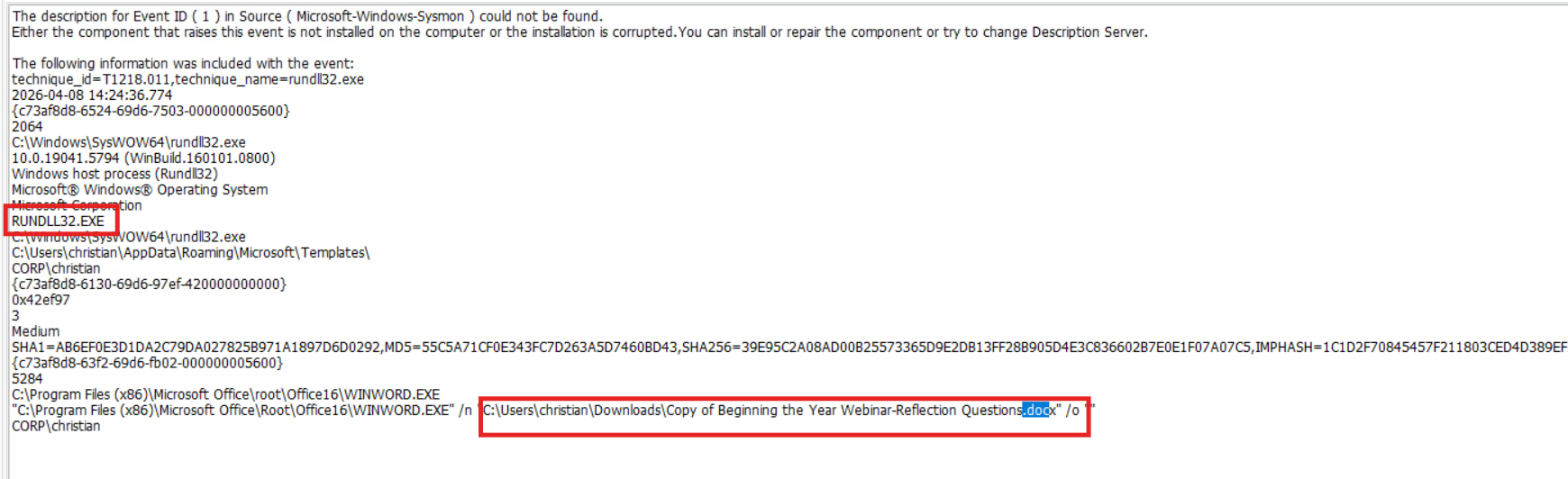
- Se puede ver dentro de Sysmon Event ID 1 y filtrando por .doc. Vemos un archivo sospechoso ya que Word normal nunca debería lanzar rundll32.exe como proceso hijo.
- Opening the malicious document triggered the execution of a child process. What is the name and PID of this process?
- Lo podemos ver dentro de la respuesta anterior.
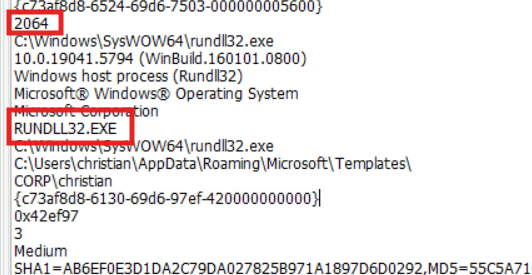
- Lo podemos ver dentro de la respuesta anterior.
Command and Control
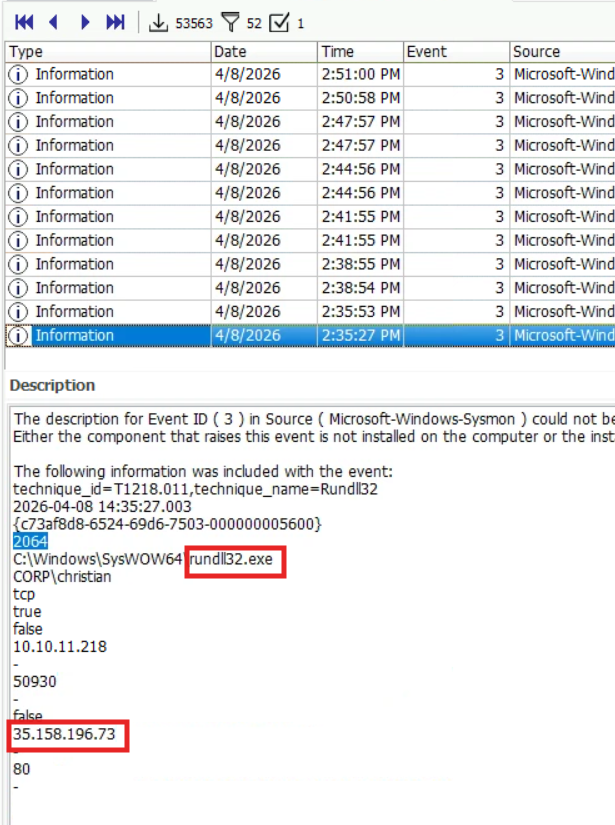
- Opening the document file triggered a connection back to C2. What is the C2 IP Address
- En este punto sabemos que al abrir el Word, se ejecutó rundll32 con el PID 2064 por lo que vamos a filtrar en Sysmon Event ID 3 por ese PID.
- Vemos que hay muchas conexiones a través de diferentes puertos pero hacia la misma IP.
Discovery
- After gaining remote shell in victim machine, attacker started his malicious activity by some discovery commands, what’s the first command executed and it’s time stamp?
- En Sysmon Event ID 1 filtramos por cmd y por fecha y hora para que nos muestre los eventos posteriores a las 14:19 del 8 de abril, que es cuando se accedió por primera vez al archivo.
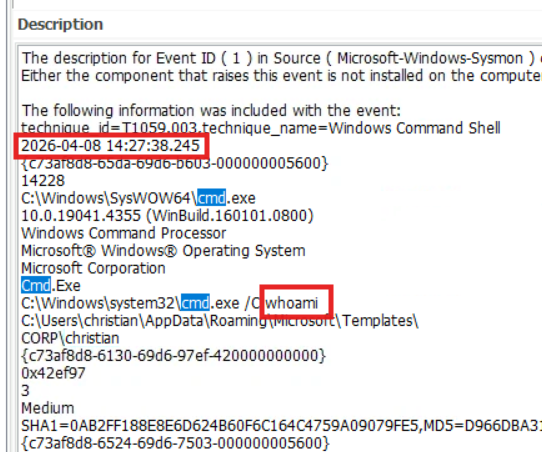
- En Sysmon Event ID 1 filtramos por cmd y por fecha y hora para que nos muestre los eventos posteriores a las 14:19 del 8 de abril, que es cuando se accedió por primera vez al archivo.
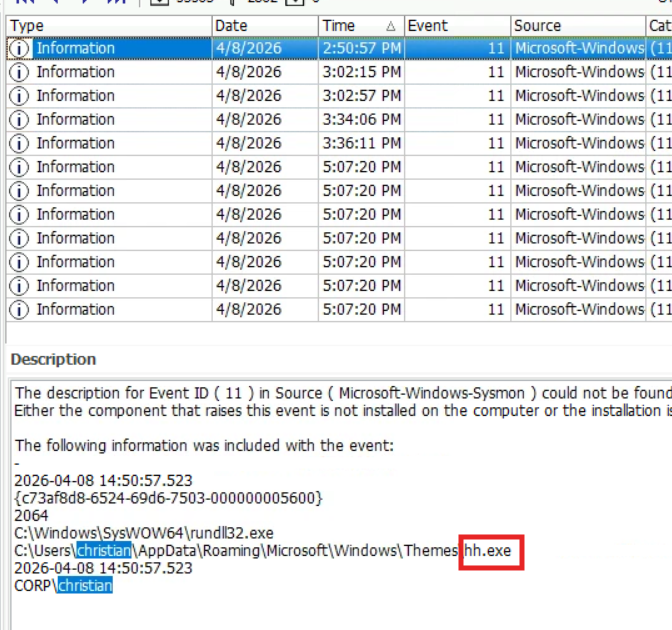
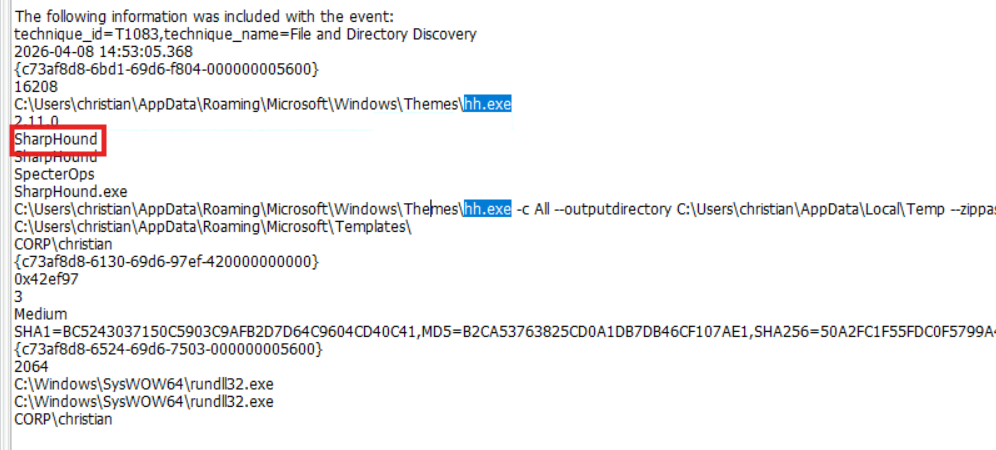
- After executing some reconnaissance, threat actor dropped and executed malicious file to perform intensive enumeration, what’s the full path of this tool, and it’s original file name?
- Como el atacante dropeó un archivo, nos movemos al Event ID 11 y filtramos por el nombre christian para afinar más el resultado
1
- Sabiendo que el ejecutable malicioso se llama hh.exe, filtramos el Event ID 1 por ese nombre y vemos el nombre original.
Privilege Escalation
- After completing enumeration successfully. The attacker escalated privileges by spawning a new rundll32.exe process running with administrative rights, giving them an elevated foothold on the host. When did this first malicious privileged rundll32.exe process run?
- Para esta pregunta tenemos que buscar a partir de las 14:35 ya que en ese momento se ejecutó el último comando de reconocimiento. A partir de ahí buscamos en Sysmon Event ID 1 filtrando por rundll32 y buscando por el nivel de integridad HIGH con el usuario christian.
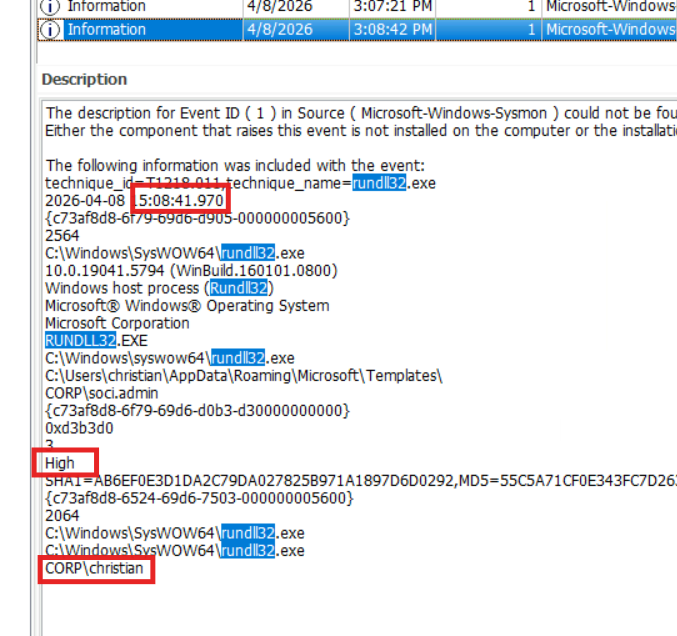
- Para esta pregunta tenemos que buscar a partir de las 14:35 ya que en ese momento se ejecutó el último comando de reconocimiento. A partir de ahí buscamos en Sysmon Event ID 1 filtrando por rundll32 y buscando por el nivel de integridad HIGH con el usuario christian.
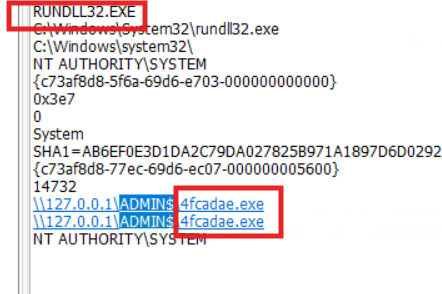
- During privilege escalation, the attacker dropped a binary onto a share to spawn additional rundll32.exe processes for later post-exploitation activity. What is the full path of this binary?
- After elevating privileges, the attacker dropped a persistence binary into a system directory, a location only writable from a SYSTEM-level context. What is the full path of this file?
- Como nos dicen que ha dejado un archivo accesible solo a través de directorios de SYSTEM, filtramos en Sysmon Event ID 11 por NT AUTHORITY\SYSTEM.
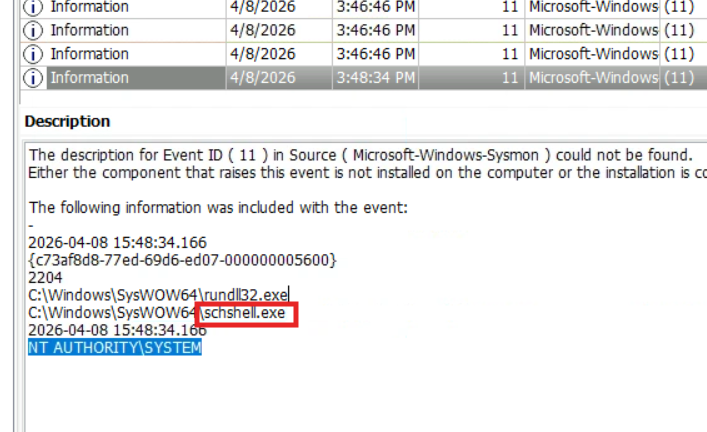
- Como nos dicen que ha dejado un archivo accesible solo a través de directorios de SYSTEM, filtramos en Sysmon Event ID 11 por NT AUTHORITY\SYSTEM.
- The attacker registered a scheduled task that re-launches the persistence binary at regular intervals. What is the name of this task?
- En Sysmon EVent ID 1 filtramos por schtask y vemos la tarea programda que, de hecho, venía codificada.
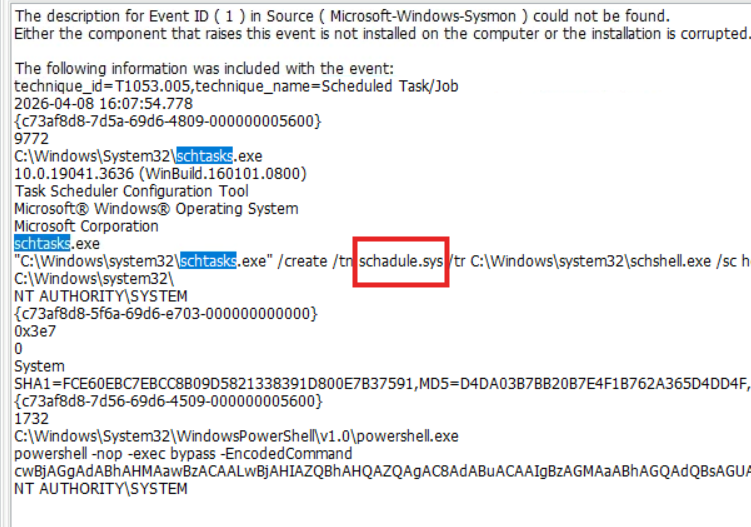
- En Sysmon EVent ID 1 filtramos por schtask y vemos la tarea programda que, de hecho, venía codificada.
Discovery
- Threat actor started a second phase of discovery, what is the 2 powershell cmdlets used by threat actor in network discovery?
- Filtramos en Sysmon Event ID 1 por el nombre del ejecutable que nos hemos encontrado anteriormente y nos aparecen dos comandos codificados muy seguidos. Decodificándolos en CyberChef nos aparecen ambos comandos.
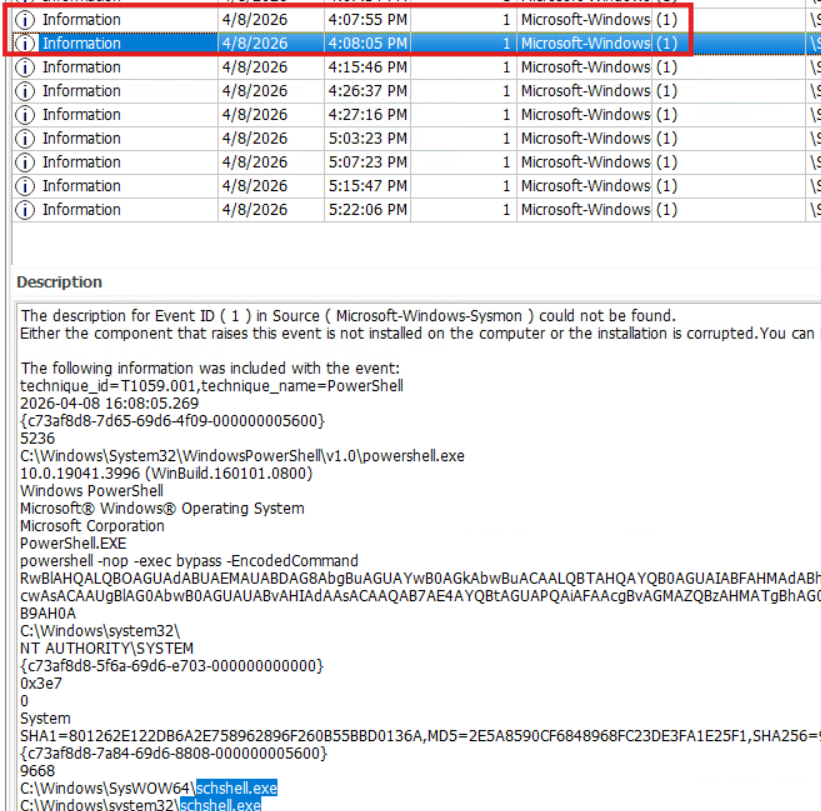
- Filtramos en Sysmon Event ID 1 por el nombre del ejecutable que nos hemos encontrado anteriormente y nos aparecen dos comandos codificados muy seguidos. Decodificándolos en CyberChef nos aparecen ambos comandos.
Credential Access
- During Credential Access, the actor targeted LSASS memory. The threat actor dropped a known system admin tool to dump the lsass. What’s the original tool name used, and what’s the file that stores the output?
- Filtramos por lsass y nos aparecen los datos.
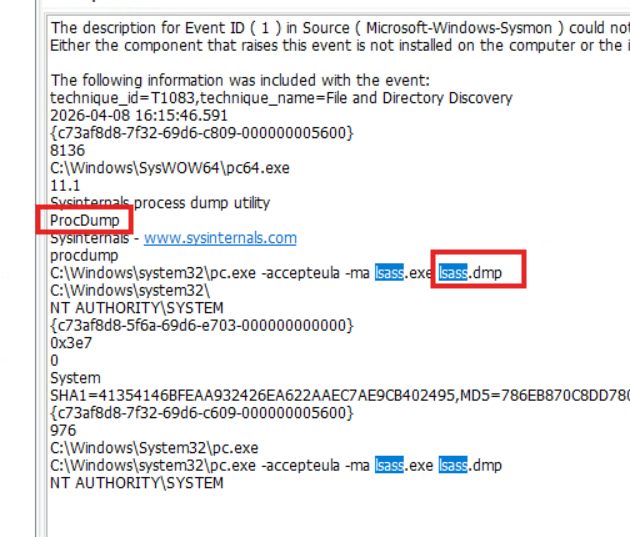
- Filtramos por lsass y nos aparecen los datos.
- The LSASS dumping binary was renamed before it was executed against lsass.exe. What’s the file path of this lsass dumper tool?
- Si nos fijamos en la imagen anterior, nos aparece la ruta del ejecutable pc.exe, previamente llamado ProcDump.
Command and Control
- After credential dumping, the attacker used the persistence executable to deploy a new client beacon to continue command-and-control?
- La clave de esta pregunta está en que el ejecutable ha desplegado un beacon nuevo, por lo que tenemos que irnos a Sysmon Event ID 11 filtrando por schshell.exe.
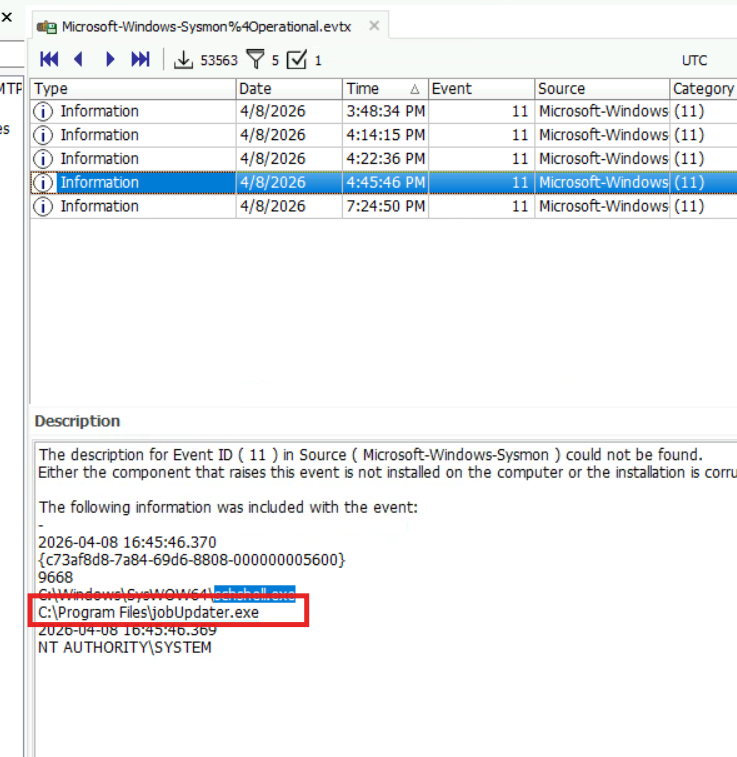
- La clave de esta pregunta está en que el ejecutable ha desplegado un beacon nuevo, por lo que tenemos que irnos a Sysmon Event ID 11 filtrando por schshell.exe.
Execution
- The process in the previous question started another process, which is the child process path?
- Nos vamos a Sysmon Event ID 11 y filtramos por jobUpdater.exe.
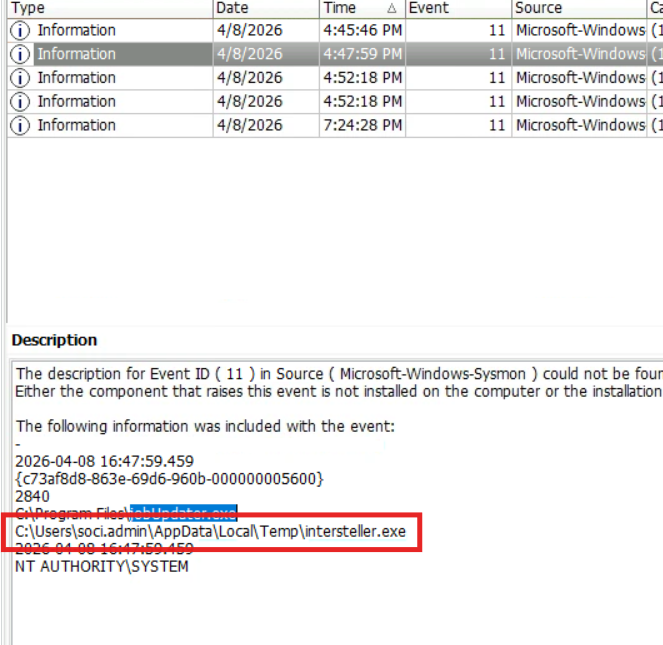
- Nos vamos a Sysmon Event ID 11 y filtramos por jobUpdater.exe.
- What’s the SHA256 hash of the child process?
- Filtrando por el ejecutable malicioso en Sysmon Event ID 1 nos aparece.

- Filtrando por el ejecutable malicioso en Sysmon Event ID 1 nos aparece.
- The last dropped file, flagged as a Rhadamanthys-family sample, was executed repeatedly during this phase. Using Windows execution artifacts, how many times was this file executed?
- Cambiamos de origen de los logs y nos vamos en busca del archivo INTERESTELLER.PF. Paseándolo con PECmd y visualizándolo con TimelineExplorer (bendito Eric Zimmerman) nos sale que se ha ejecutado 4 veces.
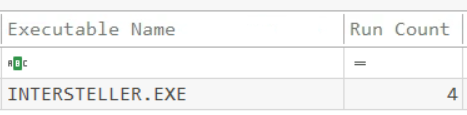
- Cambiamos de origen de los logs y nos vamos en busca del archivo INTERESTELLER.PF. Paseándolo con PECmd y visualizándolo con TimelineExplorer (bendito Eric Zimmerman) nos sale que se ha ejecutado 4 veces.
- For threat-intelligence enrichment of the Rhadamanthys Loader sample, look up its hash on VirusTotal. What is the Compilation Timestamp of this malware, and the First Seen In The Wild date?
- Corta y al pie

- Corta y al pie
- The repeated executions of the Rhadamanthys Loader suggest it was retrying to fetch its next-stage payload. Some time later, the actual Rhadamanthys Stealer DLL appeared on the host and was executed. What is the path of this last dropped file?
- Filtramos en Sysmon Event ID 1 por Powershell a partir de las 16:47 ya que esa hora fue en la que apareció el ejecutable intersteller.exe.
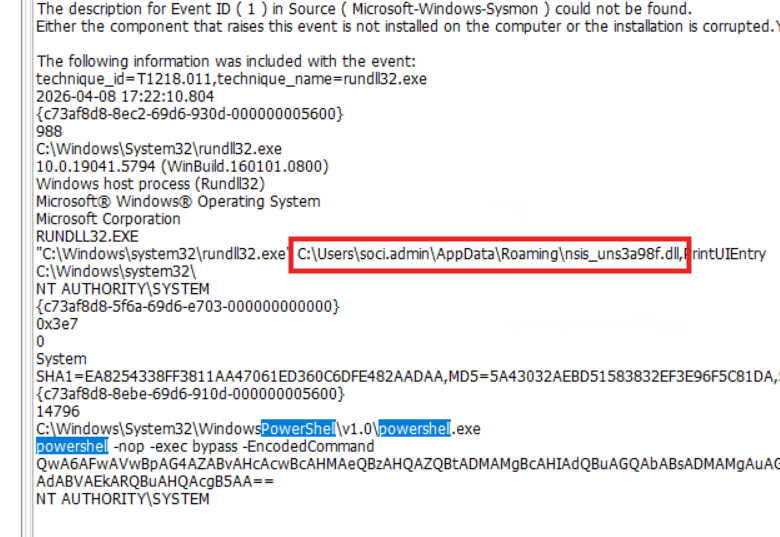
- En VirusTotal podemos ver que el formato del dll coincide con el comportamiento típico del stealer.
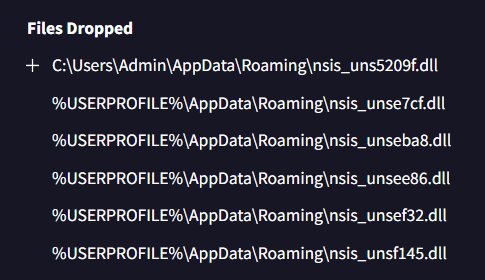
- What’s the SHA256 hash of this file on dropped on system
- Nos vamos a la carpeta donde se encuentra el .dll y sacamos el hash
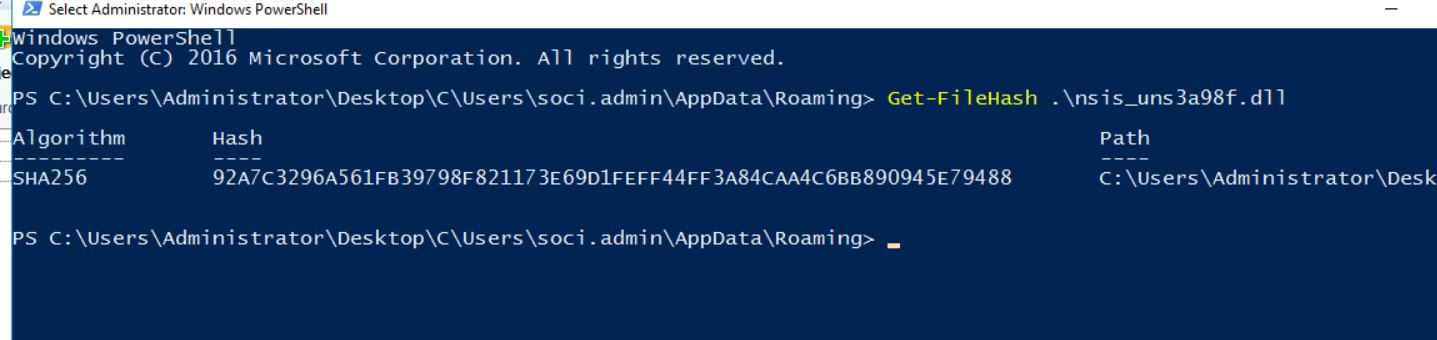
- Nos vamos a la carpeta donde se encuentra el .dll y sacamos el hash
- The final stealer DLL was invoked through rundll32.exe with an exported function name. What’s the command line that tried execute this file?
- Nos fijamos en la misma linea de comando que antes y ahí nos aparecerá con la función exportada
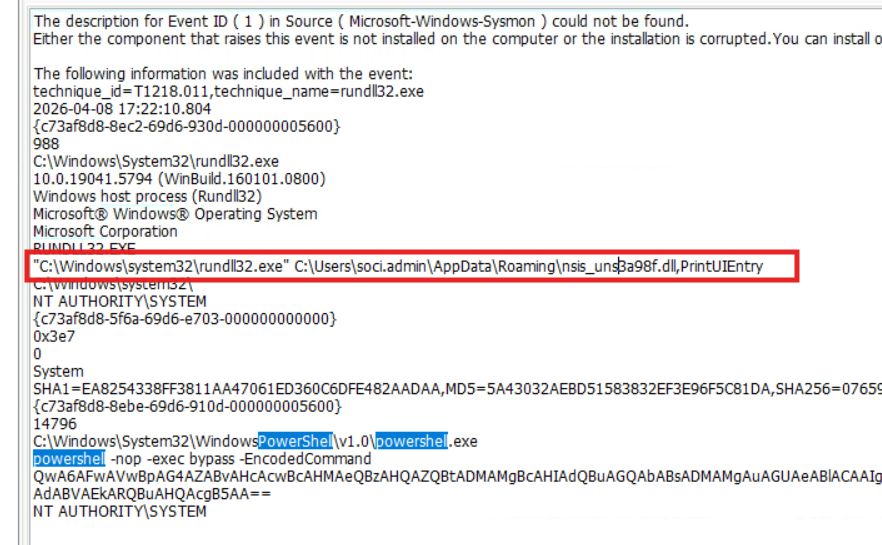
- Nos fijamos en la misma linea de comando que antes y ahí nos aparecerá con la función exportada
This post is licensed under CC BY 4.0 by the author.